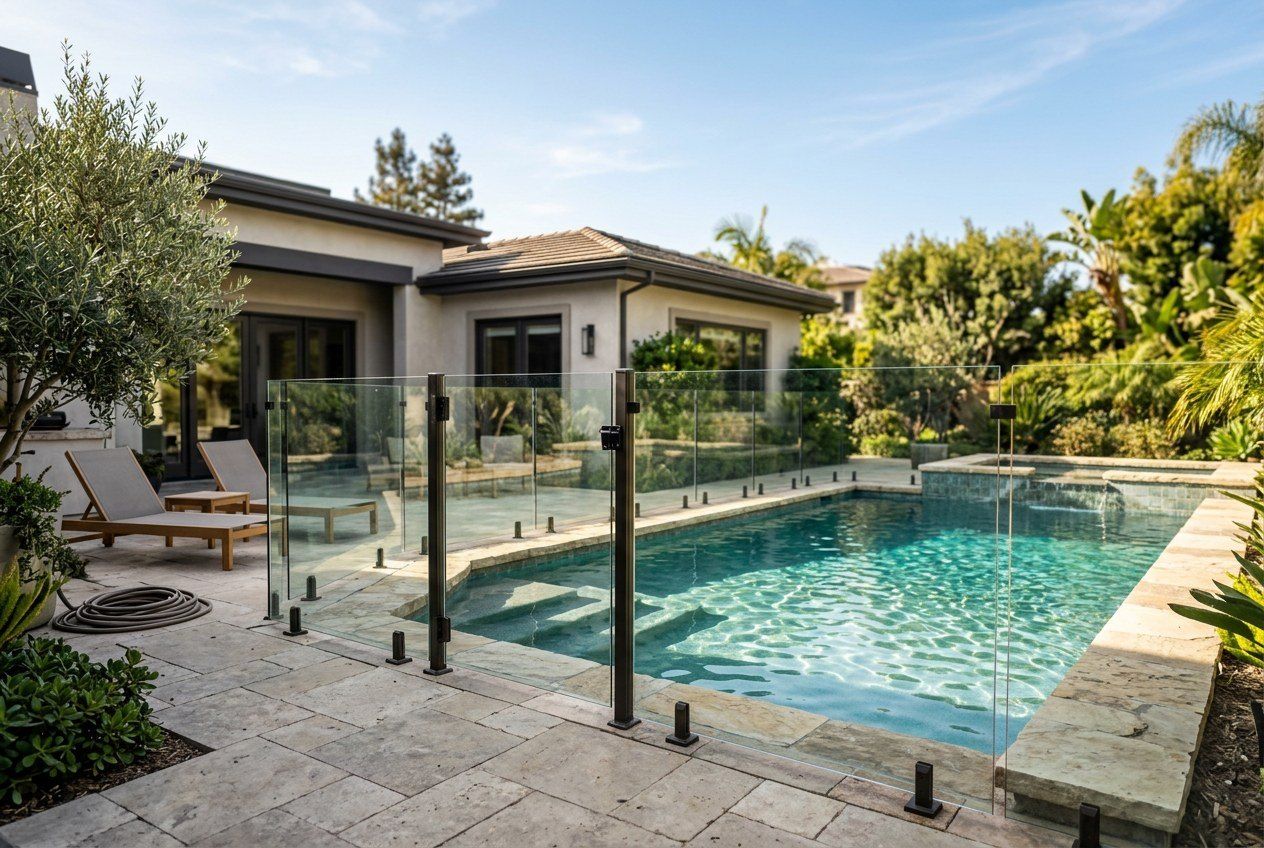
California does not require every home pool to have a fence, but when a pool or spa is built or remodeled under a permit, the law requires at least two of seven safety features. An isolation fence is the strongest of them.
The Swimming Pool Safety Act
California's rules for private homes are in the Health and Safety Code, starting at section 115920 and known as the Swimming Pool Safety Act. Under section 115922, as updated by SB 442 effective January 1, 2018, whenever a building permit is issued for a new pool or spa, or for remodeling an existing one, at a private single-family home, the pool must have at least two of these seven drowning prevention safety features:
- An enclosure that isolates the pool or spa from the home and meets section 115923.
- Removable mesh fencing that meets ASTM F2286, with a self-closing, self-latching gate that can take a key lock.
- An approved safety pool cover (meeting ASTM F1346).
- Exit alarms on the home's doors that give direct access to the pool or spa.
- A self-closing, self-latching device on those doors, with a release mechanism at least 54 inches above the floor.
- An alarm that sounds when someone enters the water, meeting ASTM F2208. Personal wristband-type alarms do not count.
- Other means of protection, if independently verified as at least as effective as the features above and tested to ASTM standards.
Cities and counties can adopt stricter rules, and many inspect for compliance at final permit sign-off. When a home with a pool is sold, the home inspector is required to note which of the features are present.
What an isolation enclosure must meet
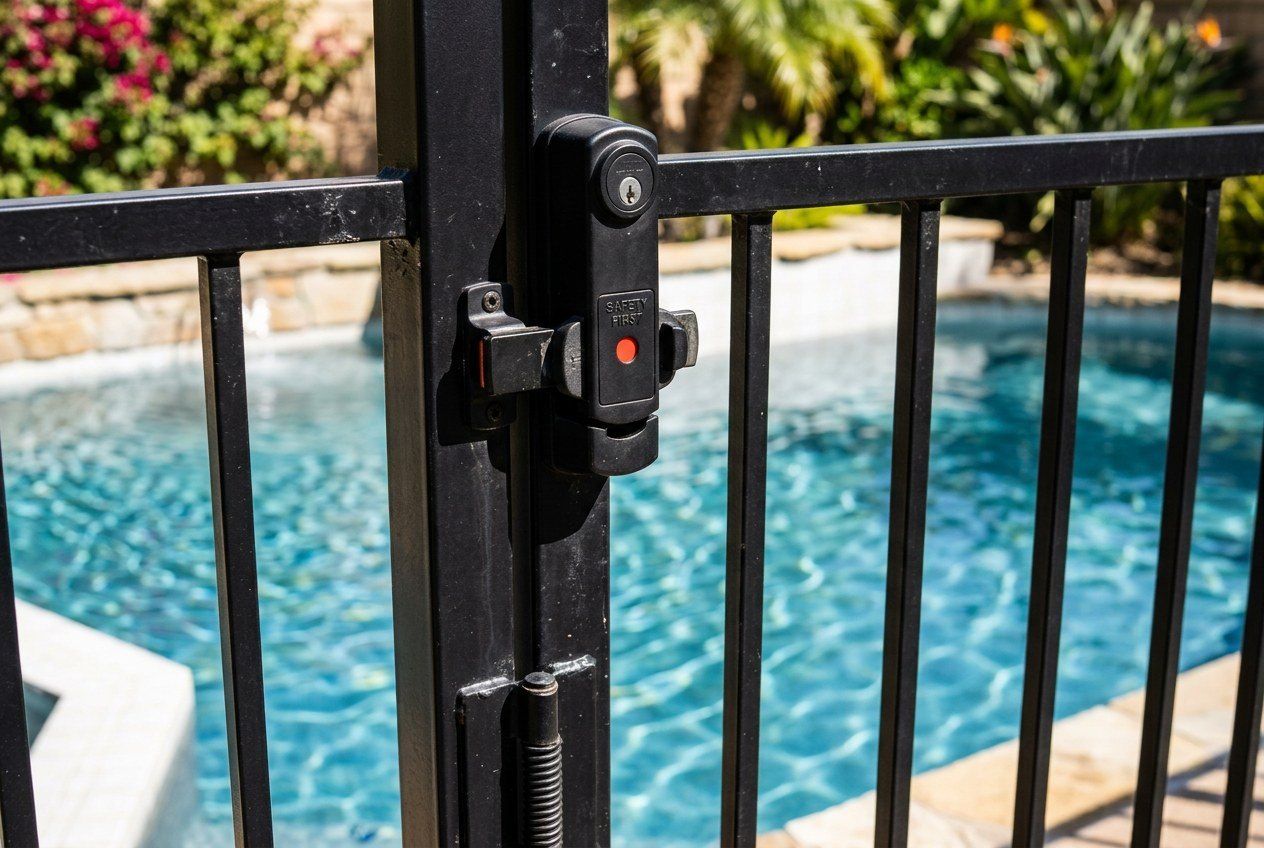
Section 115923 sets the standard for a qualifying enclosure. In summary, it must:
- Be at least 60 inches (5 feet) high, measured on the outside.
- Leave a gap at the bottom of no more than 2 inches above grade.
- Have no openings that a 4-inch sphere can pass through.
- Have an outside surface free of protrusions, cavities or other features that would give a child a hand- or foothold.
- Have gates that open away from the pool, are self-closing and self-latching, with the latch at least 60 inches above the ground.
The enclosure must separate the pool from the house, not just from the street. A fence around the yard with the house forming one side does not isolate the pool, because a child can walk out of the back door straight to the water. The CPSC's Safety Barrier Guidelines for Residential Pools recommend the same four-sided approach.
Existing pools
The two-of-seven rule is triggered by a permit for new construction or remodeling. An existing pool that has not been remodeled is not required by state law to be retrofitted, although local rules may differ and rental or licensed child-care settings carry their own requirements. For families with young children, the practical advice is the same either way: add an isolation fence, door alarms and a pool alarm, and keep gates shut.
Making a fence work in real life
- Test the gate weekly: open it fully and let go. It should close and latch on its own from any position.
- Never prop the gate open, even briefly.
- Keep chairs, planters and toys away from the outside of the fence.
- Check mesh fences for sagging or torn panels and reinstall removed sections every time.
- Store pool toys outside the enclosure when not in use so children are not drawn to the water.
Fences are one layer. Combine them with alarms, supervision and swim skills, as described in layers of protection.
Choosing a fence type
- Permanent metal or glass fencing is durable and low-maintenance; check vertical bar spacing and avoid horizontal rails a child could climb.
- Removable mesh fencing to ASTM F2286 is popular with families who want an open yard later; it must be reinstalled correctly every time.
- Wood fencing can comply but is easier to climb if it has rails on the outside.
Get it inspected
Ask your building department to confirm the features during the final inspection, and keep the documentation for when you sell.
Frequently asked questions
Is a pool fence required in California?
Not for every pool. When a permit is issued to build or remodel a pool or spa at a single-family home, state law requires at least two of seven drowning prevention features, one of which is an isolation fence. Local rules may require more.
How tall does a pool fence have to be in California?
A qualifying enclosure under Health and Safety Code section 115923 must be at least 60 inches high, with no more than a 2-inch gap at the bottom.
Which way should a pool gate open?
Away from the pool, and it must be self-closing and self-latching with the latch at least 60 inches above the ground.
Do above-ground pools and spas count?
The law applies to swimming pools and spas at single-family homes when a building permit is issued. Check with your local building department for how it applies to a specific product.