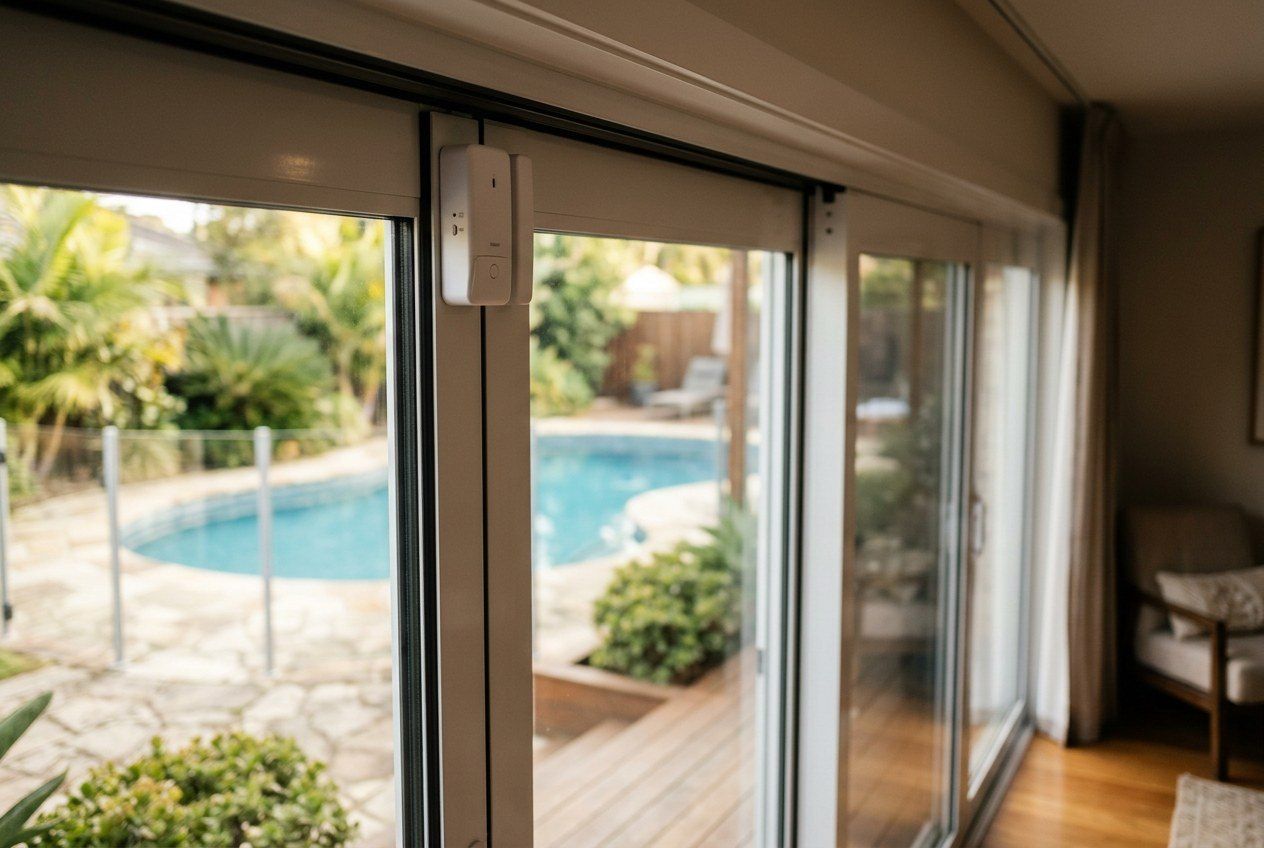
An alarm does not stop a child from reaching the water. It buys seconds by telling an adult that something has gone wrong, which is why alarms work best on top of a fence, not instead of one.
Door and window exit alarms
For most families the most useful alarm is on the house door that leads to the pool. In many drownings of young children, the child got to the pool through a door from the house. The CPSC's Safety Barrier Guidelines recommend that a door alarm:
- Sound continuously for at least 30 seconds, starting within 7 seconds after the door is opened.
- Be loud, at least 85 dBA at 10 feet, and distinct from other household sounds such as the phone or doorbell.
- Reset automatically, with a touchpad or switch that lets an adult pass through briefly. The bypass should be at least 54 inches above the floor so a small child cannot reach it.
California's pool safety law lists exit alarms on doors with direct access to the pool as one of its seven drowning prevention features. Look for door alarms listed to UL 2017.
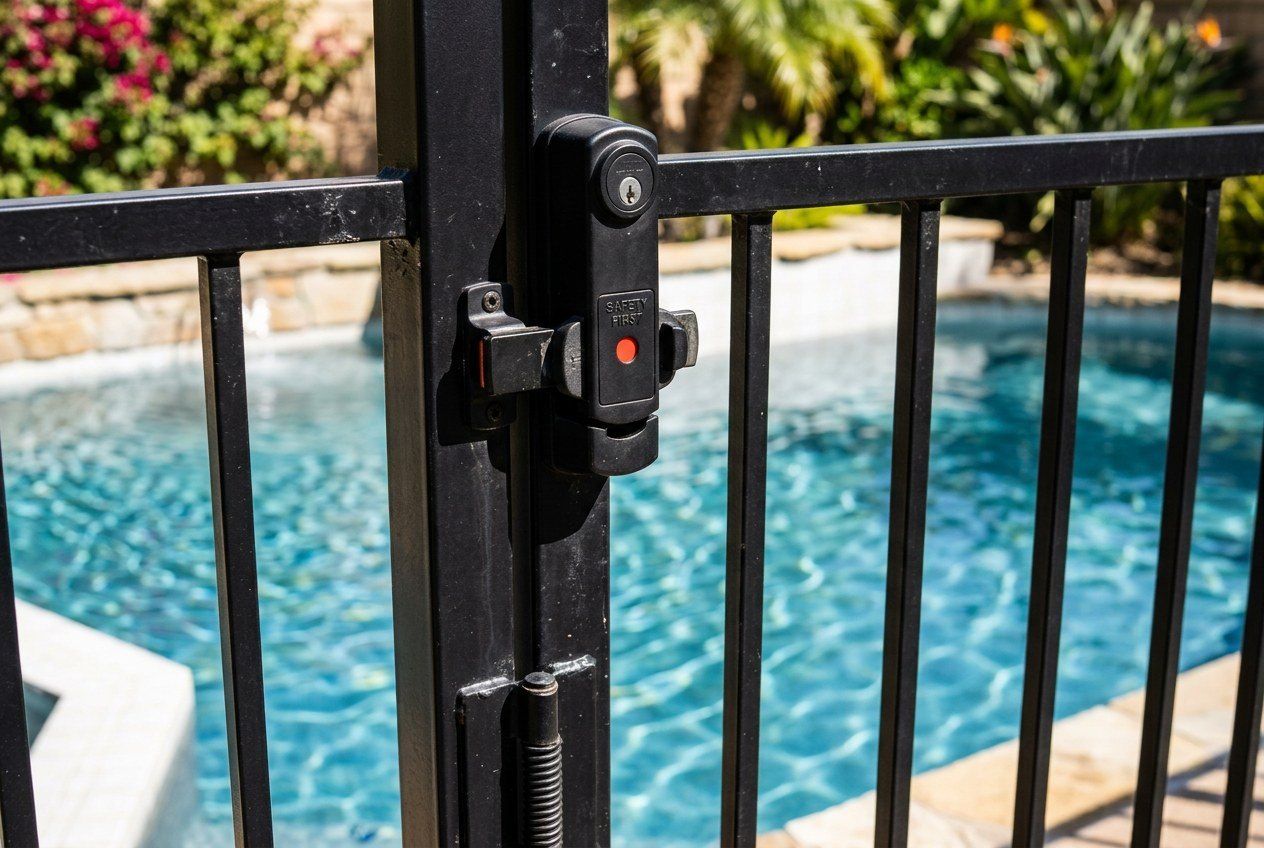
Gate alarms
Gate alarms work the same way on a pool fence gate. They are useful when the gate is in a spot where you would not hear it close, or when older children and guests use the pool area.
In-water alarms
These sit in or at the edge of the pool and detect entry into the water. Two common types:
- Surface-wave sensors float or mount at the edge and detect waves on the surface. They can be triggered by wind and rain and must be switched off during swimming.
- Subsurface sensors mount on the pool wall below the waterline and detect pressure waves. They tend to produce fewer false alarms from wind.
Look for alarms that meet ASTM F2208, the standard California's law refers to. Make sure the alarm can be heard inside the house, not just at the pool; most include a remote receiver. Remember to turn it back on after swimming, which is the step people forget most often.
Wearable alarms
Wristbands or clips that sound a base unit when they get wet are designed for an individual child. California's law specifically excludes these "swimming protection alarm devices designed for individual use" from counting as a safety feature, and they only work if the child is wearing one. They can add a layer for a toddler who wanders, but they are not a substitute for door and pool alarms.
Limits of any alarm
- An alarm only helps if an adult hears it and responds immediately.
- Batteries die; test alarms monthly and when the season starts.
- Bypass switches left on, and alarms turned off after a swim, are common failure points.
- No alarm prevents entry. Pair alarms with an isolation fence, a self-latching gate and active supervision.
See pool fence requirements in California for the full list of approved features and layers of protection for how they fit together.
Where to put alarms in a typical California backyard
- Every door from the house to the pool area, including sliding doors, garage side doors and doors from bedrooms. A single missed door is how many toddlers reach the water.
- Windows that open onto the pool area and are low enough for a child to climb through, unless they are fixed or limited to a small opening.
- The pool fence gate, especially if it is out of sight or earshot of the house.
- In the pool, as a backup layer that alerts you if a child gets past everything else.
Testing routine
- Test door and gate alarms weekly by opening each door and timing the delay.
- Test in-water alarms monthly by dropping a test weight or following the manufacturer's procedure.
- Replace batteries at the start of each season and when the low-battery warning sounds.
- Check that the remote receiver is audible in bedrooms and the kitchen.
Alarms for spas and hot tubs
Spas need the same protection as pools. A locking safety cover that meets ASTM F1346 and door alarms on access doors are the usual combination.
Frequently asked questions
Are pool alarms required in California?
Not on their own. When a pool or spa is built or remodeled under a permit, the law requires at least two of seven features; door exit alarms and in-water alarms meeting ASTM F2208 are two of the options.
What is the best type of pool alarm?
For homes with young children, door alarms on every door to the pool area are usually the most effective, combined with an in-water alarm and a fence.
Do wristband pool alarms count as a safety feature?
No. California’s law excludes personal swimming protection alarms designed for individual use from the list of drowning prevention features.
Why does my pool alarm go off in the wind?
Surface-wave alarms respond to waves on the water, including those from wind and rain. Subsurface sensors are less affected.